Poetry Readings and Feedback – Free Online Group – Tuesday December 19th, 7:00PM EST

I’m running a small online group for poetry readings and feedback on Tuesday, December 19th, 7:00PM EST. It’s free.

Feedback should be encouraging and supportive, and should be phrased in terms of your reactions as a reader (not an editor): talk about what the poem meant to you, what images stood out, what emotions you felt, what parts connected with you, or didn’t, and so on.

We’ll warm up by first doing a few famous poems by professional poets. After things get going we’ll share some of our own work. (Sharing your work is not necessary. You are welcome to participate just to give feedback, or just as a listener, if your prefer.)

There is a max group size, so if you’re interested, RSVP ASAP.

Details and RSVP here.

Gendered language and pronoun usage (ways to do it properly, and ways to do it wrong)

Around the 1960s and 70s, feminists undertook a project of feminist language reform, uncovering and correcting gendered language. Among the problems they tackled was the generic use of “he”.

Insisting that women might sometimes be the referents of generic pronouns, feminists met with the resistance of a stubborn vanguard of patriarchal language puritans, who had in their defense a long-established linguistic tradition of privileging the male perspective. But feminists won the day, eventually convincing writers not to exclude half the population from their intended readership. The only question now was how to write sentences, since everyone had learned to phrase sentences with the generic “he”.

There were four broad solutions to this problem.

  1. Alternate between “he” and “she”. This recognizes that it is exclusionary to use the masculine pronoun and, in an egalitarian move, seeks to apportion that exclusion in equal measure to men and women, distributed more or less arbitrarily throughout their work. This strategy can be called gendered pronoun alternation.
  2. Replace “he” with the compound phrase “he or she”. This replaces the exclusionary masculine pronoun with a clunky, gender-ambiguous reference composed of two gendered pronouns. This strategy can be called gendered pronoun compounding.
  3. Use the singular “they”. This recognizes that the non-gendered “they” is inclusive. It also speeds up comprehension time, relative to the generic “he”. However, it has the downside of being grating to people who are uncomfortable using “they” in the singular. This strategy can be called gendered pronoun neutrality.
  4. Reword sentences so they don’t use a generic “he”. This leads to stronger sentences in general, but requires skill to consistently execute, and careful attention paid to phrasing. This strategy can be called gendered pronoun nullification.

Ever since feminists convinced the world that women deserve equal treatment with respect to pronoun reference, there has been disagreement about how to handle that equal treatment.

Each strategy has its downsides. Compounding -“he or she”-  is cumbersome and awkward. Alternating is distracting and arbitrary. Neutrality -the singular “they”- can be grating to people who aren’t yet used to it. And the null strategy -avoiding generic pronoun use- requires attention paid to phrasing, making it harder for the speaker or writer.

Even today, all these different strategies are used by different speakers. The phrase “he or she” spiked in popularity throughout the 70s, peaking around 1980, just as we would expect from the feminist language reform movement. Gender pronoun compounding has been more-or-less consistent since then.
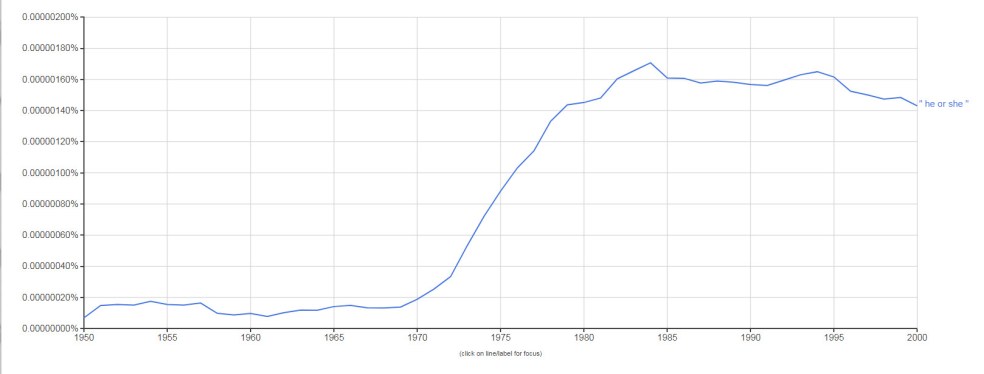
he or she usage.jpg

It shouldn’t be.

Not only is the phrase “he or she” clunky and awkward, it’s exclusionary, in precisely the same way that usage of the masculine “he” is. So is gender pronoun alternation. These strategies both exclude gender non-binary individuals. They both presume gender binarity.

Ironically, the compounding and alternating strategies, though a response to egalitarian concerns, are arguably less progressive than the antiquated “he” usage, since, while the older usage at least has the (admittedly flimsy) pretense of using “he” as a neutral pronoun, the “he or she” strategies posture as inclusive, and thereby succeed in being that much more exclusionary to gender non-binary people.

(And why “he or she” rather than “she or he”?)

We might fix either strategy by including “they” among the terms that are compounded or alternating. But once you open the door for “he or she or they” you recognize the validity of the singular “they”, so you might as well just use that. Ditto for alternating.

The only sensible strategies are gender neutrality and gender nullification. No more of this arbitrarily alternating between “he” and “she”, and no more of the clunky and exclusionary “he or she” compounds. Even without considering the exclusionary effects of these strategies, they were the worst of the four, anyways. Gender neutrality and gender nullification lead to cleaner, more elegant sentences.

It might be helpful to demonstrate how to execute gender pronoun nullification. Virginia Tufte, in Syntax as Style (which you should consider buying), provides this example of generic pronoun use (before fixing it):

When a small child encounters an angry dog, she instinctively knows that bared fangs signal great danger even without any previous learning. – Cooper and Reiman, “About Face 2.0: The Essentials of Interaction Design”

Tufte fixes the sentence this way:

A small child encountering an angry dog instinctively knows, even without any previous learning, that bared fangs signal great danger.

Tufte’s version handles the gendered pronoun issue better by phrasing to avoid generic pronoun usage. This makes it genuinely inclusive. Even without considering the gender issue, Tufte’s version is a better sentence -smoother to read and more economical, two words shorter than the original.

But writing this way requires deliberate attention paid to phrasing. It’s worth it, I think, since you end up with better sentences. But it makes the writer’s job slightly more difficult. For those writers who aren’t up to the task, the gender neutral “they” is also an option.

I would like to see the usage of “he or she” dropping. Besides being clunky and inelegant, it’s also exclusionary. It fails at achieving the only thing that it was meant to achieve. So if you see or hear someone using it, please kindly explain what’s wrong with it, or direct them to this article.


Publications in Wax Poetry and Art, and “Degenerates: Voices for Peace Homelessness Edition”

I was very happy to find out that my poem “kawasaki highway” will be published in Wax Poetry and Art, and my poem “the concrete” will be published in “Degenerates: Voices for Peace Homelessness Edition”, by Weasel Press. Both of those should be coming out soon!

Publication in Polar Borealis

My creepy short story ‘The Santas’ is going to be published in Polar Borealis! And just in time for Christmas, too!

aurora_borealis_northern_lights

I was very happy to find a good publisher for this story, and also to find that it’ll be published in time for the season.

Without too many spoilers, the premise of the story is that “Santa Claus” is just one of many “Santas”, magical beings who are summoned by using different rituals. Cookies and milk and stockings by the fireplace summon Santa Claus. But in ‘The Santas’, we meet some of the lesser known -and far creepier- Santas.

That story is coming in issue #5 of Polar Borealis, which will be free to download!

Open Call – Strange Economics SFF anthology

The Strange Economics anthology will feature SFF stories on the theme of “economics”, broadly interpreted. It’s paying a semi-pro rate of CAD1.5c/w. Simsubs are allowed. Submissions are open until January 30, 2018, so there is still some time to come up with a story, write it, polish it, and submit it.

Some ideas/prompts/suggestions for stories:

  • Job market implications of genetic engineering and “designer babies” on society: Do parents seal the employment fate of their children? Why would anyone engineer their children for the jobs no one wants?
  • What kind of work will people do when human labor is no longer necessary? Does work still exist? How are resources distributed? How do people spend their time? Explore these question in a SF world, where robots and AI have eliminated the need for work, or a fantasy world, where magic or gods have eliminated the need for work.
  • Supply and demand in a world of magic: a critical spell/ritual ingredient is in short supply.
  • Some people think capitalism is the final stage of human history, and no other systems are going to arise. If that’s right, what will the capitalism of the future look like? If that’s wrong, what other system might take its place? Tell a story about either of these futures.
  • A market for human souls: a “collector” who makes their living selling souls to demons, but questions where to draw the line (and by extension, the variable value of human life).
  • How will interplanetary trade work? What might go wrong?
  • A story that illustrates the prisoner’s dilemma in an SFF context.
  • A story that illustrates the sunk cost fallacy in an SFF context.
  • A story that illustrates negative externalities in an SFF context.
  • An SFF story that illustrates irrational economic behavior, or how biases/beliefs/ psychological predispositions sometimes make us act in ways that don’t seem to make economic sense.
  • There is an asteroid worth $10,000,000,000,000,000,000. What would happen if someone managed to collect it? Write a story about the company that makes this happen, and what happens as a result.
  • Global warming will create new economic challenges over the next hundred years. Write about one or more of those problems, and how people deal with them.
  • Space Tourism. Write about the business in the near-future.
  • Mars or moon colonies. Some run by China, one run by NASA, some run by multinational corporations. Tell a story about the differences in how they’re run, and the potential conflicts that arise, for example, when resources are scarce.
  • Pollution is an example of a market failure. Tell a story about how a future society tries to deal with this market failure. Come up with a policy solution, and tell a SF story about why it works, or doesn’t. Or, create a fantasy analogy for pollution, such as a side effect from using magic. Maybe using spells releases demons into the wild. Should the peasants be expected to deal with the demons? Or maybe the peasants get fed up with the wizards not dealing with the problem.
  • Space pirates.
  • Corporate neo-feudalism.
  • What if the gap between rich and poor continues growing? Is there a breaking point? What does that look like?

Happy writing!

Submission guidelines for Strange Economics can be found here.

first date, by David F. Shultz

In this post I’ll talk about a creepy poem I wrote called ‘first date’. This poem was published in The Literary Hatchet, issue #18. The Literary Hatchet is available as pdf for free, so I recommend downloading a copy and/or buying a paperback issue for $14.00.

lh18cover200
Anyway, I’ll show you the poem first, and then say some things about what I was trying to do when I wrote it:

first date
by David F. Shultz

first date
always an adventure
blind date
I can see
you’re a tad cold.
cold feet?
shivers
I’ve got shivers
in the spine
it’s a fine thing
that I’ve got
thick skin
now where to begin
our night?

empty stomach?
(that calls for analysis)
heart on your sleeve?
(or in the vicinity)
can I pick your brain?
(a little prodding will suffice)

but first
there’s the meat
slab
silver platter
take the knife
carve carefully
after that
I’ll find out all
about you
I always do
on first dates
it just takes
precision

This poem is disguised as a “first date”. Or rather, it is a “first date” in the mind of the demented speaker, who is performing on autopsy, an activity that he finds particularly thrilling.

The first stanza is meant to create a subtle awkward note. It’s supposed to give the impression of an overeager person on a date, perhaps off-putting, repeating and stumbling over their words, making awkward and cliche comments, variously either too probing or too self-centered.

You might notice already by this point the body-metaphors piling up, “thick skin” and “cold feet” and “shivers in the spine”. These body metaphors continue in the next stanza with “empty stomach” and so on. The speaker really has bodies on his mind.

The second stanza, besides piling on the body metaphors, is also meant to introduce a more clinical tone. It’s phrased as a procedural question-and-response, like checking items off a list. We also see the introduction of polysyllabic words capping off every second line -“analysis”, “vicinity”, “suffice”- in a poem that has mostly consisted of monosyllables. Each of those words contains an ‘s’ sound, which I hoped would create an insidious, snake-like edge.

In the final stanza the “meat/slab” arrives, which is really the body about to be autopsied. Humans being compared to meat is always unsettling (and maybe especially when there is a demented human standing over them with a knife).

I want to focus in particular on what I was trying to do with the final word of the poem: “precision”. The entire poem was building up to this word, and this moment in the poem. This is the moment that our demented speaker has been waiting for. I tried to do several things to make this word “pop”.

  • content: “precision” is a strange word to cap off the speaker’s thought about what it takes to learn about someone, and this odd word choice might signal that something interesting is happening
  • rhyme: the previous four lines established a rhyming structure that is broken “you/do” and “dates/takes”
  • number of words per line: 2 or 3 words in the previous 4 lines, down to 1
  • length of words: 1 or 2 syllable words in the previous 4 lines, up to 3
  • echoing second stanza: “precision” echoes the clinical words used in the second stanza -“analysis”, “vicinity”, “suffice”- including the ‘s’ sound

The reason I tried so hard to make this word pop was because it is the central moment that the poem -and the speaker- has been building to: this is the scalpel making an incision. I hoped to convey this incision without mentioning it directly, by way of resemblance with “precision”, by drawing attention to the final line (in the various ways itemized above), and by talking about a knife and meat and carving carefully.

As to whether any of those techniques worked, that judgment has to be left to the reader, of course. But either way, I thought some people might be interested in what was going through my mind as I was building this poem.

I hope you liked the poem and that you found my thoughts on it interesting!

Also, please support the publisher of the poem, The Literary Hatchet, by checking out the website and downloading (free!) and/or purchasing a copy of issue #18, in which this poem appears.